I’ve never been one to chase the loudest car in the room. But there’s a difference between loud and memorable, and the Pink Pig Porsche occupies that rare space where a joke becomes art. This 1971 917/20, painted like a butcher’s cut diagram, wasn't just a Le Mans experiment—it was a moment when Porsche let itself be playful without losing its soul. The car’s official name was the 917/20, but everyone remembers the Pink Pig Porsche.
It’s easy to dismiss the livery as a gimmick. Pink paint, dashed lines, labels for “chops” and “ham”—it sounds like something from a marketing offsite. But look closer. The shape underneath was itself a curiosity: a widened, re-bodied 917 designed to reduce drag and improve high-speed stability. The nose was blunt, the hips flared, and the whole thing looked… plump. So when the designers at Porsche’s racing department were brainstorming liveries for Le Mans, someone—likely Anatole Lapine, the head of styling—suggested something that acknowledged the car’s curvaceous silhouette. The Pink Pig was born.
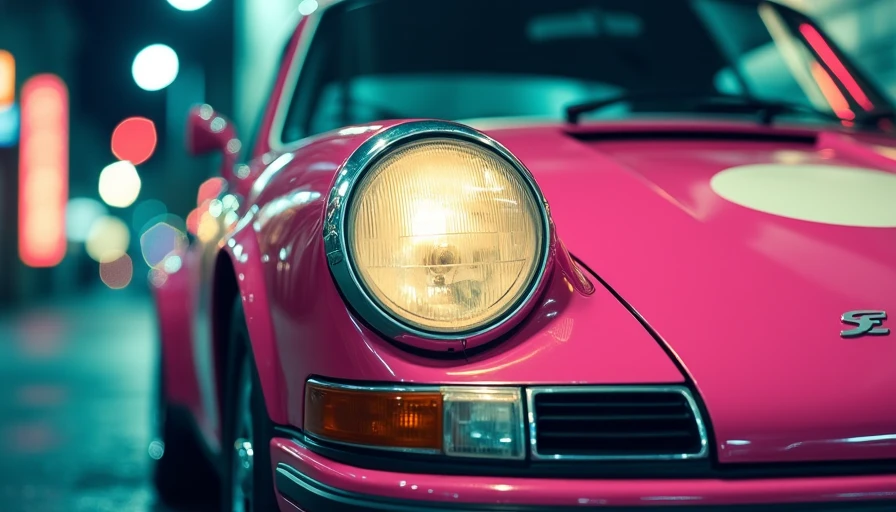
The Birth of an Unlikely Livery
The story goes that the paint scheme was a quiet rebellion against the era’s serious racing liveries. While Gulf’s blue and orange dominated, and Martini’s stripes defined the factory cars, the Pink Pig Porsche offered something else: wit. The car wasn’t meant to be a joke at Porsche’s expense; it was a wink from inside the team. The butchery references were chosen because the car’s wide body reminded the engineers of a pig—a term of endearment, not insult. The labels—“Tête de Cochon” (pig’s head), “Jambon” (ham), “Côtelettes” (chops)—were applied with clinical precision, turning the car into a mobile anatomy chart. It was irreverent, but the execution was flawless. The pink wasn’t bubblegum or pastel; it was a muted, almost dusty rose that worked beautifully against the white of the cut lines and black of the lettering.
This wasn’t a marketing stunt. The Pink Pig Porsche was raced once, at the 1971 24 Hours of Le Mans, driven by Willi Kauhsen and Reinhold Joest. It qualified 5th and led its class before a brake issue forced retirement after 12 hours. The car disappeared afterward, eventually scrapped—as many race cars were in those days. But the legend stubbornly remained.
Why Proportion Matters
What fascinates me about the Pink Pig Porsche isn’t the novelty; it’s how the livery highlights the car’s unusual proportions. The 917/20’s bodywork was wider than the standard 917 by several inches, with fenders that bulged like a sports car that had skipped leg day—top-heavy but purposeful. The pink paint unifies those shapes, while the dashed lines trace the car’s contours, drawing the eye along the curves. In photographs, the car looks almost cartoonish, but in person—I’ve seen a faithful recreation at a vintage race—it has an unexpected elegance. The color softens the aggression of a car that could reach 220 mph. It’s the same principle that makes a tailored suit look better in charcoal than black: restraint creates nuance.
Legacy Beyond the Track
The Pink Pig Porsche never won Le Mans, but it achieved something rarer: it became an icon without being the fastest or most successful. Today, the original car is gone, but Porsche has honored it with replicas and references. The 2018 911 RSR ‘Pink Pig’ that raced at Le Mans was a direct homage, using a modern interpretation of the livery. Even the die-cast models and art prints that fill my bookshelf testify to its staying power. Why? Because the Pink Pig represents something we don’t see enough in motorsport: humility. It’s a car that laughs at itself, that acknowledges its own ridiculousness, while still being a serious racing machine.
For me, the Pink Pig Porsche is a lesson in how character can outweigh performance on the scales of memory. The best cars don’t ask for attention—they hold it. This one does so with a wink and a label that says “ham.” That’s the kind of design restraint that feels like freedom.
Frequently Asked Questions About the Pink Pig Porsche
**Was the Pink Pig Porsche actually a Porsche factory entry?**
Yes, it was a factory-backed entry under the Martini & Rossi Porsche team. The car wore number 23 and competed in the 1971 Le Mans. Despite the playful livery, it was a serious effort to test the wide-body aerodynamics.
**Why did the livery use a pig theme?**
The name came from the car’s plump shape. Engineers jokingly called it the “pig” because its wide fenders and rounded nose resembled a pig’s body. The livery turned that joke into a butcher’s diagram, labeling cuts of meat like “ham” and “chops.” It was a playful nod to the car’s proportions.
**Is the original Pink Pig Porsche still in existence?**
No. The original 917/20 chassis was scrapped after the 1971 season, as was common with race cars at the time. However, Porsche built a faithful replica in the 2010s, and several private collectors have created their own tributes. The livery lives on through these replicas and modern Porsche models like the 2018 911 RSR.
**How has the Pink Pig influenced modern Porsche designs?**
Porsche has revisited the Pink Pig livery several times, most notably on the 2018 911 RSR. The car’s design—a wide, aggressive 911—echoes the 917/20’s stance. The livery remains a fan favorite, proving that a bit of humor can become an enduring part of a brand’s heritage.
*Photo credit: The author’s own cameras and archival sources.*