I’ve spent years in and out of cars that cost three times what a Civic does, and I keep returning to the same conclusion: the Honda Civic interior, especially in its current generation, understands something many pricier cabins forget. It doesn’t try to impress you with leather you’ll never maintain or screens that demand constant attention. Instead, it offers a quiet competence—a space that works with you, not against you. This is a cabin designed for living, not for show.
The moment you settle into the driver’s seat, the proportions feel right. The dashboard stretches horizontally, placing controls exactly where your hand naturally falls. The materials—soft-touch plastics on the door tops, textured metal-look trim, and a subtle grain on the dash—avoid the cheap, shiny finishes that age poorly. Everything you touch has a deliberate weight: the steering wheel buttons click with assurance, the turn signal stalk offers a damped, tactile satisfaction. This is not luxury in the traditional sense, but it is something more lasting: integrity.
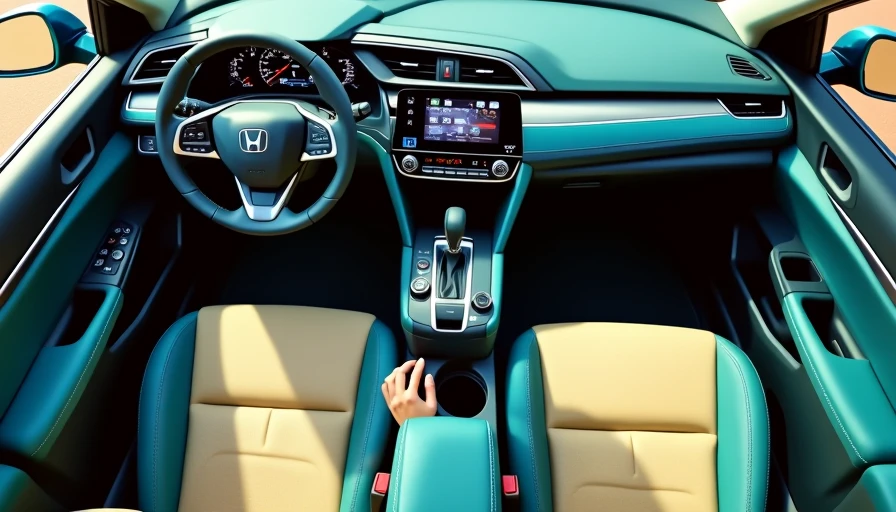
What strikes me most about the Honda Civic interior is how it balances space and intimacy. The front seats are generously bolstered without being confining; you can spend six hours in them and emerge without a sore back. The rear seats offer surprising legroom for a car that looks compact from the outside—a fact that matters when you’re carrying friends or gear. The trunk opening is wide and low, making it effortless to load a weekend’s luggage or a set of track-day wheels. Usability, as I’ve often written here, is part of beauty. The Civic proves that.
The Quality of Light and Material
In the top trims—like the Touring or the Sport Touring—Honda adds leather seating, a power-adjustable driver’s seat, and a premium Bose sound system. But the real upgrade is in the details: the stitching on the dash, the perforated leather, the ambient lighting that softly illuminates the footwells at night. Even in the base LX, the cloth seats are durable and pleasant to the touch, and the metallic-finish inserts break up what could be a monotone sea of dark plastic. The cabin feels airy thanks to the slim A-pillars and large windows, giving you a clear view of the road and the scenery beyond.
I’ve driven a Civic Si for a week, and its interior takes the same foundation and adds just enough flair: red stitching on the wheel and seats, a metal shift knob that feels cool and precise, and sport seats that hold you snugly during brisk cornering. The Si cabin doesn’t shout; it quietly assures you that this car was designed with a driver in mind. The Type R, for all its visual aggression, has an interior that remains surprisingly livable—though I’d argue the standard layout is already so good that you’re not missing much unless you need that extra performance.
Layout: Designed for the Driver, Comfortable for Everyone
The infotainment system, once a weak point, has matured. The 9-inch touchscreen on higher trims responds quickly, and physical knobs for volume and tuning remain—a small grace that many manufacturers have abandoned. Apple CarPlay and Android Auto connect wirelessly, so you never have to fumble with cables. The digital gauge cluster is clear and configurable, showing what you need without clutter. The centre console offers a deep bin with a sliding armrest, and the door pockets can hold a large water bottle plus odds and ends.
Crucially, the Honda Civic interior makes you feel in control. The driving position is low but not theatre-like, the steering wheel telescopes generously, and the pedals are perfectly spaced for heel-toe downshifts if you’re so inclined. The seats, as I mentioned, are excellent—even after a long day of canyon runs and coffee stops, you step out refreshed rather than stiff. This is the kind of daily usability that transforms a car from a mere appliance into a companion.
The Civic Interior in Everyday Life
I live in Santa Barbara, and the Civic suits the coastal rhythm flawlessly. The cabin stays quiet at highway speeds—wind noise is well suppressed—and the dual-zone climate control keeps things comfortable without drama. The materials are easy to clean; I’ve spilled coffee on the fabric seats and a quick dab with a damp towel left no trace. Storage cubbies are thoughtfully placed: a pocket ahead of the shifter for your phone, a sunglasses holder overhead, and cupholders that actually hold a 32-ounce bottle.
For those who appreciate a hand-polished dashboard or the scent of aged leather, the Civic offers something different: a serene, rational space that lets you focus on the road. It doesn’t ask for attention. It holds your life—your coffee, your bags, your weekend plans—without fuss. That, to me, is the highest compliment you can pay an interior.
Final Thoughts on the Honda Civic Interior
If you’re shopping for a compact car and you care about how a cabin makes you feel—not just how much tech it packs—the Honda Civic interior is hard to beat. It demonstrates that thoughtful design, quality materials, and ergonomic precision don’t require a six-figure price tag. The Civic sharpens your driving life without overwhelming it, and that’s exactly the kind of car I want to live with.
The best cars don’t ask for attention. They hold it. And the Civic interior holds yours, not through spectacle, but through quiet confidence.